

Sound hire for clear, powerful audio: matching PA hire to venues and audiences
Getting sound right is the difference between a message that lands and one that gets lost. Whether you are planning an autumn conference, an indoor concert, or a festival field, the PA must fit the room, the audience, and the content. LSS Live combines industry-leading equipment with an experienced engineering team to design, tune, and operate systems that stay clear and consistent from the front row to the back.
This guide breaks down line array vs point-source, subs and delay hangs, coverage mapping, SPL targets, microphones and IEMs, stage monitoring, and noise management. You will also find practical examples for small corporate presentations, medium concerts, and festival fields so you can choose with confidence.
Our expert engineers lead site recces, produce RAMS, and provide on-site operation so cues are precise and shows stay on schedule.
Core system choices: line array vs point-source
Choosing between line array and point-source starts with throw distance, audience shape, and ceiling height.
Line array: best for long-throw coverage, tall rooms, arenas, and outdoor fields. Vertical control helps keep energy off ceilings and reduces slap-back.
Point-source: ideal for shorter throws, corporate rooms, low ceilings, and distributed systems where compact boxes reduce visual impact and reflections.
In small and medium rooms, a high-quality point-source rig often delivers better intelligibility with fewer boxes and faster rig times. For larger halls or uneven floors, a compact line array can keep SPL more even across seats and balconies.
Subs, delay hangs, and coverage mapping
Low-frequency energy defines impact, but it must be controlled. Cardioid or gradient sub arrays can reduce rear spill onto stage mics and nearby properties, improving clarity and neighbour relations. In deeper rooms or outdoor sites, delay hangs extend coverage without pushing the main PA too hard. Coverage mapping should balance:
Target SPL for content type, typically 92 to 98 dB LAeq at FOH for amplified speech and light music, and 98 to 104 dB LAeq for concerts, subject to venue rules and licensing.
Evenness within ±3 to 6 dB across audience areas.
Direct-to-reverberant ratio, with arrays or point-source boxes aimed to keep energy on people, not walls or ceilings.
LSS Live performs pre-show modelling and on-site alignment so the system behaves predictably in the real room, then refines EQ and timing during soundcheck.
Speech intelligibility, microphones, and monitors
For conferences and panels, speech intelligibility is the priority. Directional capsule choice, clean gain structure, and sensible stage layout all help. Typical approaches include:
Headset or discreet lavalier mics for presenters who move.
Podium goosenecks for lecterns with tight pickup and reduced spill.
Handheld wireless for Q&A and awards.
Stage foldback kept low and directional to avoid comb filtering, with in-ear monitors (IEMs) for music segments or when podium foldback is impractical.
Where backline or multiple open mics are involved, we deploy IEMs and directional wedges with careful EQ and cardioid subs to keep the stage quiet and the mix clear.
Noise management and SPL targets
Local conditions and licensing often set limits. Our team manages dB levels by content, time of day, and location. Techniques include:
System tuning that prioritises clarity over raw level.
Sub arrays that reduce off-site spill.
Real-time SPL logging at FOH and at perimeter points.
Communication with promoters and stage management so peak moments are planned, not guessed.
Example packages by event type
Small corporate presentation, 80 to 250 people, hotel ballroom or lecture theatre
Point-source mains with compact subs for tone, not volume.
Two to four wireless channels plus lectern mic, stage foldback as required.
Room-tuned EQ to prioritise speech and keep spill off walls and screens.
Operator at FOH mixing cues, walk-ons, and VT playback integration.
Medium concert, 400 to 1,500 people, theatre or hall
Compact line array or powerful point-source with flown subs or cardioid ground stack.
Front-fill for the first rows, optional delays for balcony or rear floor.
Monitors or IEMs per artist preference, with separate monitor world.
Show file prep, system alignment, and dB management to house rules.
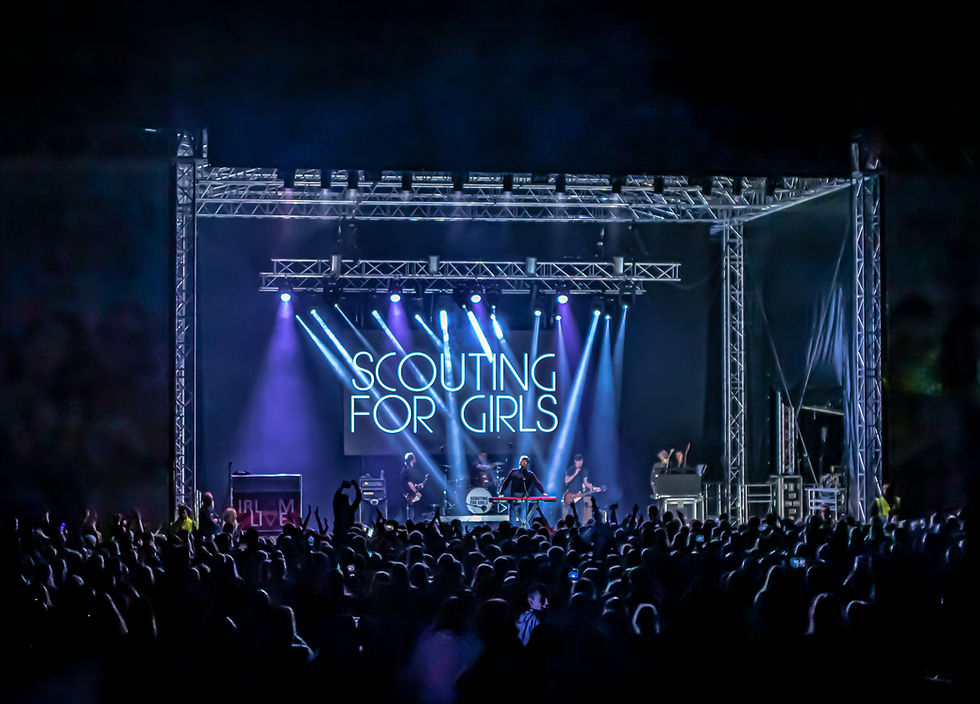
Festival field, 2,000+ outdoors
Line array mains with flown or ground-stacked cardioid subs.
Delay towers to reach the back without overdriving the main hang.
Robust monitor world with wedges and IEMs, RF coordination, weather-ready power and rigging.
Noise management plan with perimeter checks and wind-aware tuning.
Installation effort: subs, delays, and rigging
How difficult is it to install a subwoofer? In a hire context, installation is typically straightforward when handled by a competent technician. The complexity lies in placement, array configuration, crossover and polarity settings, and time alignment with mains. For delays and flown elements, safe rigging and correct networking add steps that our engineers manage as part of a controlled build.
LSS Live approach and on-site engineering
Great equipment needs qualified oversight. Our expert engineers conduct site recces, produce RAMS, coordinate power and rigging, oversee temporary works where staging is involved, and manage inspection and sign-off. On show days, operators handle FOH and monitor mixes, cue timing, and SPL logging so your programme runs to time.
If you need integrated delivery, explore our event production overview to see how audio, lighting, staging, and power join up in one plan. For stage footprints and backstage flow, our stage hire guidance helps align stage size with audience and show format.
See how joined-up AV production supports conferences and concerts: https://www.lsslive.co.uk/av-hire-and-event-production
Review staging options that pair with PA hangs and monitor worlds: https://www.lsslive.co.uk/stage-hire-and-staging-solutions
Explore professional sound systems for hire when you need clarity and coverage: https://www.lsslive.co.uk/sound-equipment-hire
FAQ
What sound system is best for small events? In most small rooms, a quality point-source system with a compact sub provides clean speech and light music with minimal visual impact. Add front-fills for the first rows and keep monitors directional.
How much does it cost to hire speakers? Costs vary with room size, audience numbers, duration, crew needs, transport, and on-site operation. The best route is a tailored quotation after a site recce and outline schedule.
What are the different types of sound systems? Common formats include point-source boxes, line arrays, distributed ceiling or delay speakers, and subwoofer arrays in cardioid or gradient configurations. Choice depends on throw distance, coverage shape, and venue limits.
What speaker has the best sound quality? Quality is about correct design, placement, tuning, and an appropriate model for the room. A well-tuned system that suits the space will outperform a larger system used in the wrong context.
How difficult is it to install a subwoofer? Physical placement is simple, but correct crossover, polarity, EQ, and time alignment are essential. In professional settings, an engineer handles these steps to integrate the sub with the mains.
Lighting and sound, joined up
Most events need coordinated lighting and sound. We align power, rigging points, and cueing so walk-ons, stings, and VT rolls land cleanly. Services typically include:
Sound: PA design and tuning, FOH and monitor operation, IEMs and RF coordination, dB management within venue limits.
Lighting: fixture selection and plots for key, fill, and backlight, rigging and programming, operator provision, and camera-friendly colour temperature.
For detailed sound plots, lighting plots, and power schedules, request a site recce and specification sheet.
Summary
Clear audio starts with a system matched to the room and audience, then refined through coverage mapping, sensible SPL targets, and precise operation. From small corporate sessions to indoor concerts and open fields, LSS Live designs, tunes, and runs systems that stay consistent and compliant, supported by expert engineers on site.
Request a site recce and specification sheet.

Comments