

UK Stage Hire Guide: Sizes, Load Ratings and Safety Essentials
- LSS Live
- Jul 27
- 5 min read
The complete UK guide to stage hire: sizes, load ratings, and safety essentials
Late-summer shows move fast. Dates lock, artists confirm, and suddenly the stage decision sets the tone for everything else. Get it right and you gain sightlines, clean changeovers, and a show that feels effortless. Get it wrong and you inherit risk, delays, and overspend.
This guide walks UK organisers through stage sizing, rigging capacities, roofs, and compliance so you can specify with confidence. Combining industry-leading equipment with an experienced engineering team, LSS Live supports every stage of the production process to professional, auditable standards.
If you need a quick shortlist, you can jump to package clarity and LSS Live solutions at the end. Otherwise, read on for detail that de-risks planning.
Stage sizing vs audience and footprint
Start with your programme, audience density, and site constraints. The right footprint balances performance space, wing capacity, and backstage workflow while protecting sightlines for the crowd.
Small community shows and school galas: A 6 m x 4 m to 8 m x 6 m deck suits acoustic acts, speeches, and small ensembles. Allow 1 m to 1.2 m trim height for visibility over a standing crowd and steps both sides for safe access.
Four-piece band baseline: Plan 6 m x 4 m minimum with a 2 m x 2 m drum riser, plus 1.5 m wings for monitor world and backline swaps. If you expect lively movement or guest players, 7.5 m x 5 m is more comfortable.
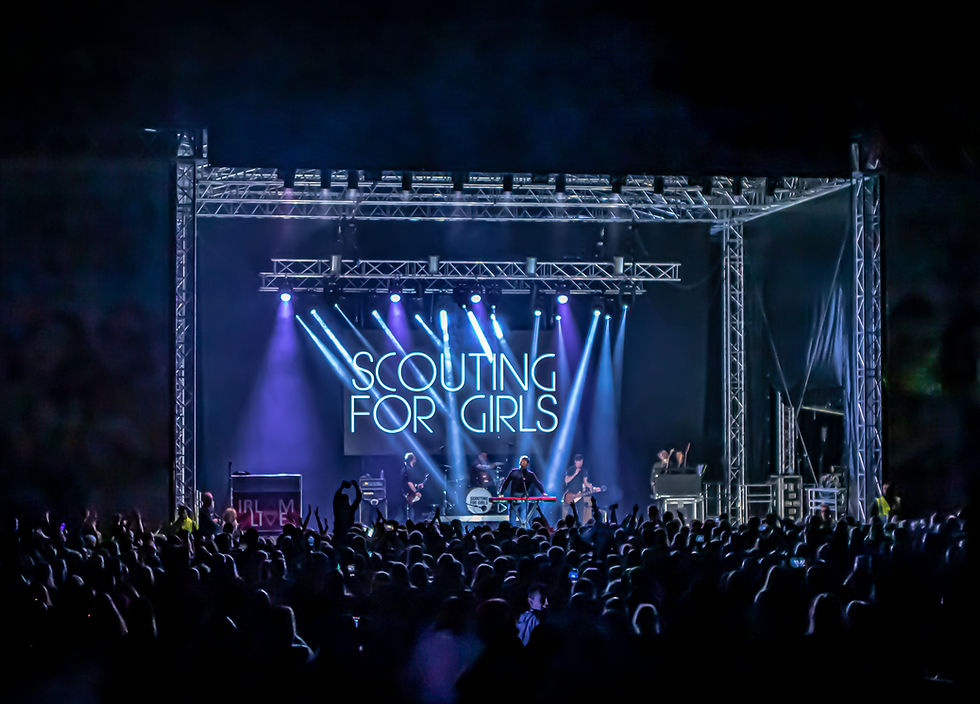
Outdoor concerts: Typical footprints run 10 m x 8 m to 12 m x 10 m with integrated PA wings, side sheds for monitors, and a rear loading ramp for rolling risers.
Festivals and multi-artist bills: 12 m x 10 m and above, with generous wing depth for pre-built backline, rolling risers, and quick-turn changeovers.
Sightlines matter. Keep front-of-stage clean, step back scenic elements, and avoid tall cases parked near the downstage edge. Backstage, allocate a clear load-in lane, 2 m safe routes either side, and protected cable runs behind the set.
Load ratings and roof systems
The roof structure determines what you can hang and how safely you can operate in weather. Always check the manufacturer’s documentation for uniformly distributed load (UDL), point loads, and wind performance.
Roofs and rigging: Look for truss spans and specified rigging points that comfortably support your lighting, sound, LED, and scenic loads. PA wings should have dedicated capacities and approved pick points, not improvised lifts.
Lighting and sound: If you plan fixture-heavy rigs or large line arrays, validate headroom and load paths early. Rigging plans should show total weight per beam, per point, and overall UDL against the stage’s rated capacities.
Wind ratings: Temporary stages are certified to operate up to a stated wind speed with and without side walls. Define a wind management plan that includes monitoring, partial de-rig thresholds, and show stops aligned to the roof’s paperwork.
LSS Live’s flagship GR 1250 stage is engineered for high load capacity with integrated PA wings and efficient rigging layouts that accelerate builds while protecting compliance.
Safety and compliance
UK outdoor staging falls under Health and Safety Executive (HSE) and Construction, Design and Management (CDM) duties. You need proportionate risk management and competent persons in control.
Our expert engineers lead site recces, produce RAMS (risk assessment and method statement), oversee temporary works and ballast, and manage the full build, inspection, and sign-off. That discipline underpins safe operation and a smooth show.
Key areas to cover:
Temporary works and ballast: A competent engineer assesses ground conditions, ballast weights and placement, and confirms restraint for forecast wind.
Documentation: RAMS, manufacturer data, inspection records, handover certificates, and a wind action plan should be in place before rehearsal.
Ground protection and access: Protect turf and buried services, plan plant routes, and keep emergency egress clear.
Weather contingencies: Define wind triggers, rain protocols, hot weather policies, and show-stop calls. Brief these to stage management, security, and artists.
For joined-up delivery, LSS Live also provides integrated event production and technical event management, aligning staging with audio, lighting, power, and crew flow.
Efficiency on show day
Speed and safety are allies. Design the deck and backstage to minimise handling and waiting.
Ramps and loading: A rear ramp and wide access steps reduce manual lifts and keep changeovers predictable.
Cable management: Use under-deck or bridged runs for power and signal, with clear crossings and no trip hazards at stage edges.
Quick changeovers: Rolling risers for drums and keys, labelled patch looms, and pre-rigged PA wings cut minutes from every swap.
Power interfaces: Place distro near monitor world with clean routes to FOH and LED processors. Agree connectors and spare capacity during advance.
Crew flow: Mark one-way routes, hold areas, and safe zones for plant. Keep visitors out of pinch points.
Package clarity
Know what is typically included vs what sits outside standard stage hire.
Usually included:
Deck and under-structure, roof system, handrails, skirts
Integrated or add-on PA wings and fly hardware (capacity dependent)
Steps and, where specified, a loading ramp
Ballast (if included in engineering plan)
Handover documentation and inspections
Commonly additional:
Plant and operators, barriers and pit, ground protection, and fencing
Power generation and distribution, FOH structures, cable ramps
LED screens, lighting packages, sound systems, risers beyond the base spec
Site security, welfare, and traffic management
If you are scaling beyond a simple platform, consider bundling with cohesive event production so rigging, power, and timelines align.
LSS Live solutions
For outdoor concerts and festivals, the GR 1250 stage combines high load capacity, integrated PA wings, quick-build rigging geometry, and roomy side sheds for monitors. Modular systems scale down for community shows and conferences, with configurable steps, ramps, and drum risers.
Our engineers manage the full build, on-site inspections, and sign-off, coordinating with sound, lighting, and power teams for safe, efficient delivery. To align staging with your overall plan, explore our stage hire and staging solutions and complementary AV support such as lighting design and stage lighting hire.
Discover stage hire options suited to festivals, outdoor concerts, and conference stages at LSS Live’s staging solutions page: https://www.lsslive.co.uk/stage-hire-and-staging-solutions
For cohesive lighting that matches your roof and rigging capacities, see our lighting design and rental lighting equipment services: https://www.lsslive.co.uk/lighting-hire-and-design
If you are consolidating sound, screens, and control, our AV production covers audio visual services from concept to show day: https://www.lsslive.co.uk/av-hire-and-production
FAQs
How much does a stage cost to hire?Costs vary with size, roof type, load rating, site conditions, duration, transport, and crew. Community platforms are typically far less than full festival structures with PA wings and ballast. Request a tailored quotation after a site recce and outline schedule.
How big is a suitable stage for a four-piece band?Plan at least 6 m x 4 m with a 2 m x 2 m drum riser and 1.5 m wings for monitors. For more movement or guests, 7.5 m x 5 m improves comfort and sightlines.
What are the stage requirements for events?Safe access, appropriate deck size and height, certified roof and rigging capacities, RAMS, temporary works sign-off, ballast, ground protection, clean power interfaces, and defined weather procedures.
What are the different types of concert stages?Modular deck systems, arched or truss roof stages with integrated PA wings, mobile trailer stages for rapid deployment, and bespoke configurations for scenic shows.
What is concert staging?It is the combined platform, roof, rigging, access, and backstage workflow that supports performance, lighting, sound, and show control.
What are the basic parts of a concert stage?Deck and legs, roof and truss, handrails and skirts, steps or ramps, PA wings, rigging points, cable management, and often drum and keys risers.
What is included in a typical stage hire package?The deck, roof, handrails, skirts, steps, and where specified, ramps, PA wings, ballast, and handover documentation. Plant, barriers, power, FOH, and screens are commonly additional.
Summary and next step
Choosing the right stage is a balance of footprint, load rating, and safe operation, backed by clear paperwork and fast backstage workflow. With the GR 1250 for high-capacity shows and scalable modular options for smaller events, LSS Live pairs proven equipment with expert engineers who plan, build, inspect, and sign off.
Request a site recce and a specification sheet to match stage size, load rating, and logistics to your venue and programme.


Comments